

Third club meeting of the season, and you're coaching your new partner through cross-ex. How to take a hostile question without flinching. How to answer short and hand the other team nothing. Your partner nods the whole way through.
Then the practice round starts. The other team fires its toughest question at your partner, and your partner answers it like it's nothing: calm, short, done. A year of watching an older sibling's rounds will do that. You knew about the sibling. You just never asked what those rounds taught them.
That's twenty minutes of club you won't get back. And it runs the other way too. If you're the newer half of the team, you've probably nodded through an explanation of something you already knew, because saying "I've got this one" felt like bragging. Meanwhile, the thing neither of you can do yet sits untouched until a round finds it.
An experienced debater wrote to us recently about what she'd do differently in her first Team Policy season. Before teaching her new partner anything, she'd find out what he already knew. The two of them could have skipped what he already had down and spent that time on what he didn't.
She's right, and finding out takes ten minutes. Here's the audit, how to read the answers, and what to do with them before your first tournament.
Why new partners guess wrong
Hardly anyone starts Team Policy from zero. Most new competitors have been at club for a while. Plenty did speech first, so they already know how to stand up, hold a room, and finish on time. Some flowed an older sibling's practice rounds from the couch for a year before they ever debated. Some took a formal logic course and can spot a leap in reasoning faster than you can.
None of that shows up on its own. Nobody opens a new partnership by listing what they're good at, because it sounds like bragging. Nobody lists what scares them either, because that sounds like weakness.
So both of you guess. The more experienced partner guesses low and over-explains. The newer partner guesses that the scary part will sort itself out by the first tournament.
Two debaters guessing about each other aren't a team yet. They're just two people at the same table.
The 10-minute partner audit
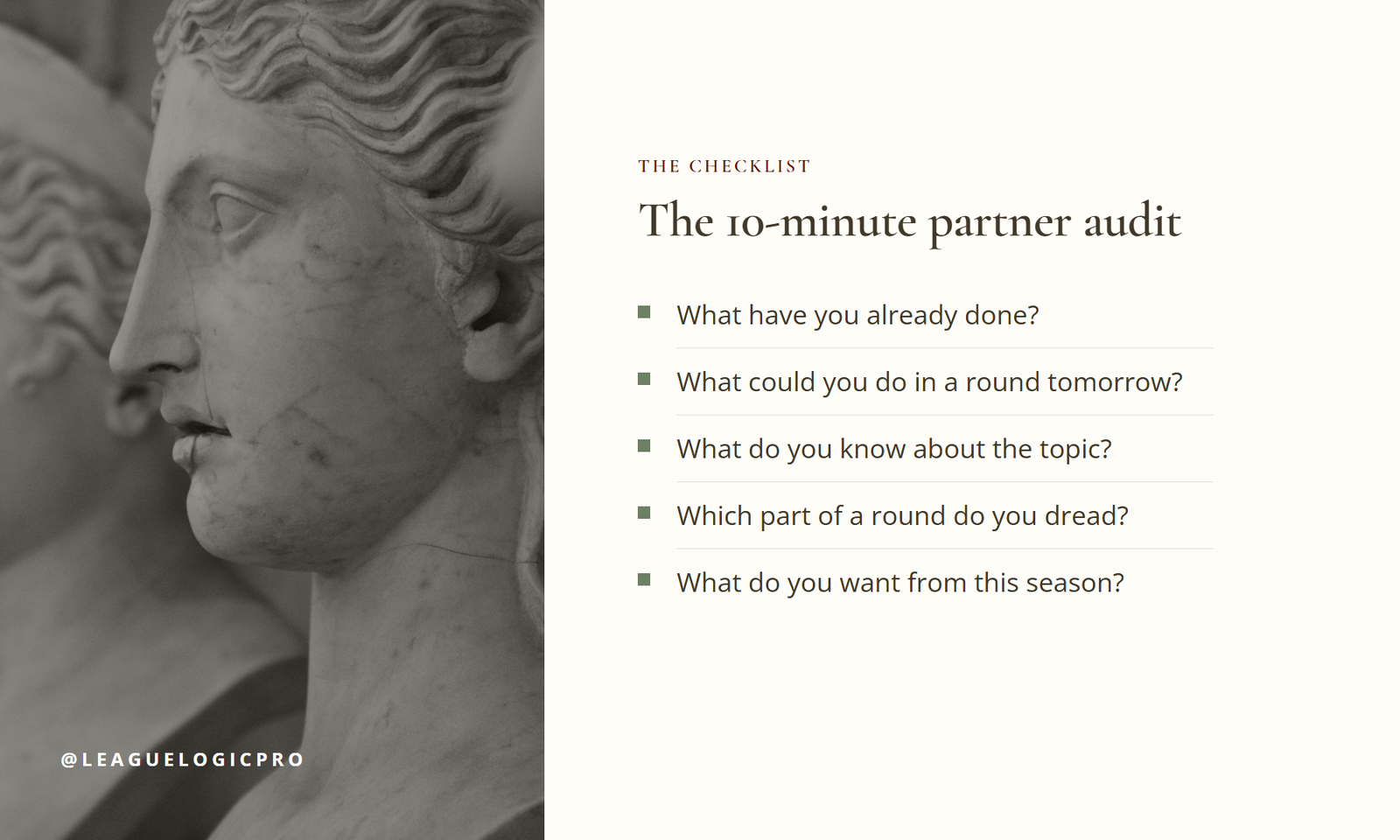
Sit down at your next club meeting with one sheet of paper and ask each other five questions. You both answer every one. No speeches and no defending your answers - just honest ones.
1. What have you already done?
Every event, every year, plus the things that don't seem to count: a logic class, an older sibling's practice rounds at the kitchen table, the rounds you've watched at club. Then ask the follow-up the opening scene skipped: what did it teach you?
2. What could you do in a round tomorrow?
Flow a full speech. Ask a cross-ex question that sets something up. Read the 1AC at speaking pace without stumbling. Answer an argument you've never heard before. Rate each one "yes," "sort of," or "not yet."
3. What do you already know about the topic?
A partner who reads history for fun may already know more about Turkey than your case does. Find out before you split the research.
4. Which part of a round do you dread?
Cross-ex? The last rebuttal? A disadvantage you've never heard of? Say it out loud. What you dread is usually what you haven't practiced, not what you can't do.
5. What do you want from this season?
A break at your first tournament? Regionals? Nationals? If one of you wants to break and the other just wants to get through a round without freezing, find that out now, not on the drive home from your first tournament.
Skip, split, drill
Put your two sheets side by side. Every skill on them lands in one of three piles.
- Skip: anything you both answered "yes." If you can both flow, you don't need another club meeting on flowing. That time is yours again.
- Split: anything one of you has and the other doesn't. For now, the partner who has it carries it in rounds and teaches it in one short session, not three meetings. Teaching it sharpens the teacher too.
- Drill: anything neither of you has. That's your plan between now and your first tournament: one gap per club meeting, in practice rounds where losing costs nothing.
Start the drill pile with whatever came up under question four. The part of the round you dread is the part a good team will find first, so find it yourselves while it's still free.
A gap between partners isn't the problem. A gap nobody says out loud is.
What ten minutes saves you
The audit settles arguments new teams can carry for weeks. Who gives which speeches stops being a coin flip. Who cuts which cards stops being whoever feels guilty first. And when one of you freezes in cross-ex at your first tournament, it won't be a surprise you both pretend didn't happen. It'll be the drill you already planned for the week after.
It changes how you practice, too. A flow drill with a partner who already flows wastes both your afternoons. A cross-ex drill with the partner who dreads cross-ex might be the most useful hour you spend all month. (If the vocabulary itself is the gap, start with our debate jargon decoder. If flowing is, here's the flowing system that wins rounds.)
Run it again after your first tournament
Your first tournament will grade the audit for you. When your ballots come in, read them together, then run the five questions again. A few of your "yes" answers will turn out to be wishful. A few "not yet" answers will have quietly become "sort of" without either of you noticing. Both are worth knowing before the next tournament.
The teams that climb fastest aren't always the ones who started with the most experience. They're the ones who knew exactly what they had and spent every club meeting on what they didn't.
Ten minutes, then the real work
You don't need a coach to run this, and you don't need to be the experienced one. You need one sheet of paper, five questions, and the nerve to answer the fourth one honestly. Do it at your next club meeting.
Then test your answers on something real. Grab the free case on this year's Turkey resolution: the full affirmative case, its aff backup, and the neg brief written against it. Read the 1AC while your partner flows it, cross-examine each other on it, then take turns answering the neg brief out loud. One afternoon with it shows you which of your "sort of" answers are really a "yes" and which are a "not yet." Get the free case bundle here.