
The first club meeting of the season has a soundtrack: the veterans, catching up at full speed. We finally broke at Regionals. I cut forty cards this summer. Nobody in the region will have a brief on what we're building. You nodded along with everybody else and caught maybe half of it.
Half the words in your first club meeting are not in any dictionary.
And it's easy to sit in that circle convinced everyone else was born knowing this language. They weren't. Debate vocabulary is small - a couple dozen words carry almost every conversation - and each one does double duty. It tells you what people are saying, and it quietly tells you how the game is won.
Here's the decoder, in the three families the words actually come in.
The evidence words: cards, briefs, and the box
Most of the words flying around a club meeting trace back to one thing: evidence, and the journey it takes from a search result to a printed page in your hands.
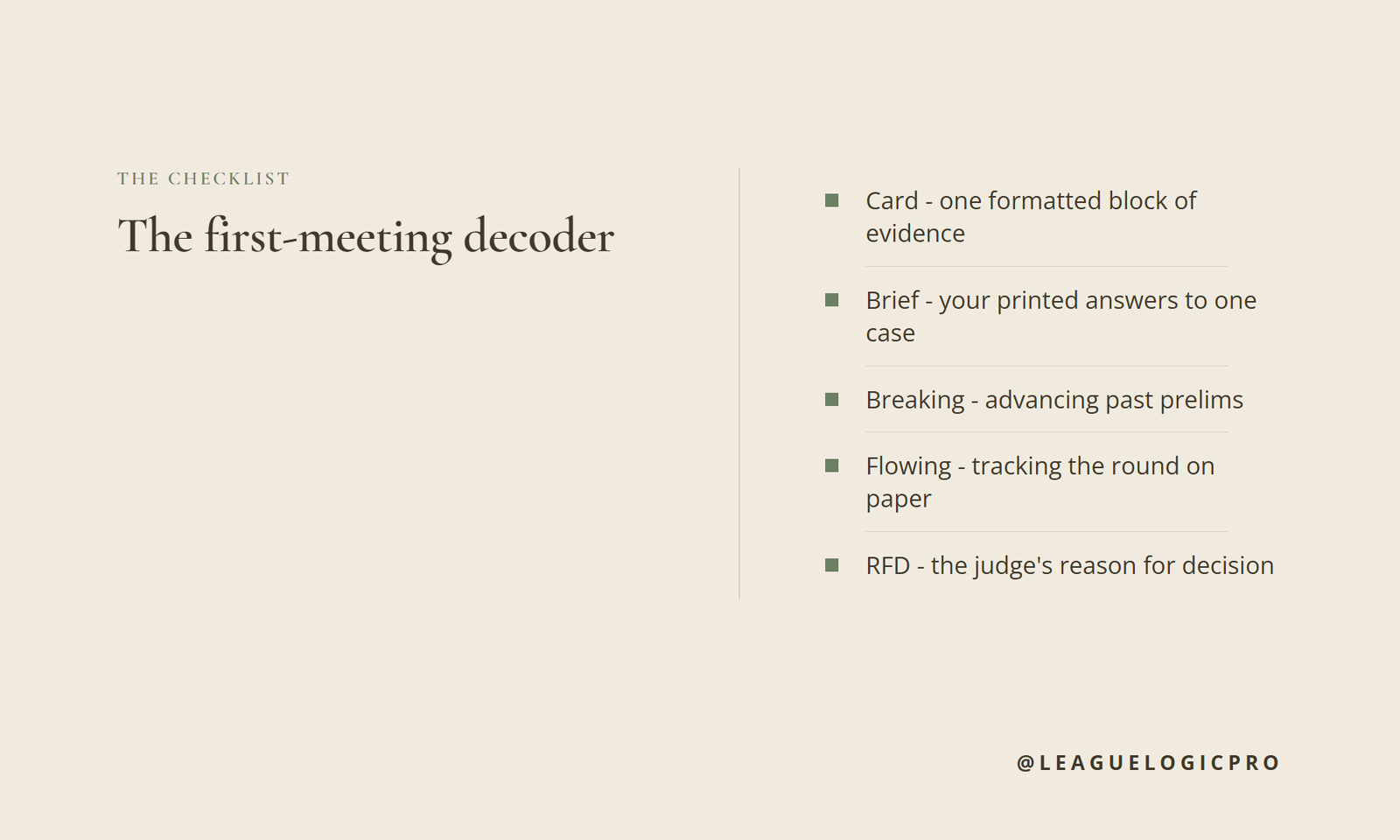
A card is one block of evidence, formatted for a round: the quote, the full citation, and a short summary line on top called the tagline. Cutting cards means finding those quotes and formatting them, and it's the single biggest time sink in debate prep. When a veteran sighs about a long night of cutting, that's the work they mean.
Organize your cards against a specific case and you have a brief - your printed answers to that case, with stacks of evidence on every argument you plan to run at it: its topicality, its solvency, the disadvantages it would cause, and more. Buy a whole packet of cases and briefs written by alumni and that's a sourcebook, a word you'll hear constantly because so much of the league preps from them.
And the debate box? The tub where all of it lives, printed and sorted. Students run their side of the round on paper - printed evidence, handwritten flows - even though the judges type their ballots on laptops. So that box beside a veteran's chair isn't clutter. It's their whole season so far, organized - and it keeps filling all year, as new research becomes new briefs.
Now listen to the circle again. "I cut forty cards this summer for our new brief" stops being noise: they found forty pieces of evidence, made each one round-ready, and filed them into their answers to somebody's case - some against its solvency, some against its topicality, every stack ready to pull. The vocabulary was never the hard part. The work is - and there are faster ways through the card-cutting grind than most novices find on their own.
The round words: the 1AC, the flow, and the drop
The round words describe structure, because a debate round isn't a freeform argument. It's a sequence of speeches with jobs, tracked line by line on paper.
Everything starts with the resolution - the question the whole league debates for a season. This year it's United States foreign policy toward Turkey. Your team builds a case on it: the argument you'll refine and defend round after round. On the affirmative, the heart of your case is the plan - the specific change you're proposing and have to be ready to defend from every angle.
The 1AC is the First Affirmative Constructive: the opening speech of the round, and the only one written completely in advance. That little code cracks the rest of the schedule for you. The number is the speaker, and it stays with them the whole round - the same person gives every speech that starts with their number, so the 2N delivers both the 2NC and the 2NR. The first letter is the side, affirmative or negative. The last letter is the speech's job, constructive or rebuttal - and both sides give both kinds. Once you can read it, the whiteboard at club stops looking like algebra. (When you're ready to write yours, here's how to build a 1AC judges can actually follow.)
Flowing is the note-taking system debaters use to track every argument through the round - each speech a column, each argument a line, nothing allowed to vanish. It matters enough that it gets a full post of its own soon. For now, hold onto its sharpest consequence: an argument that gets made and never answered is called a drop.
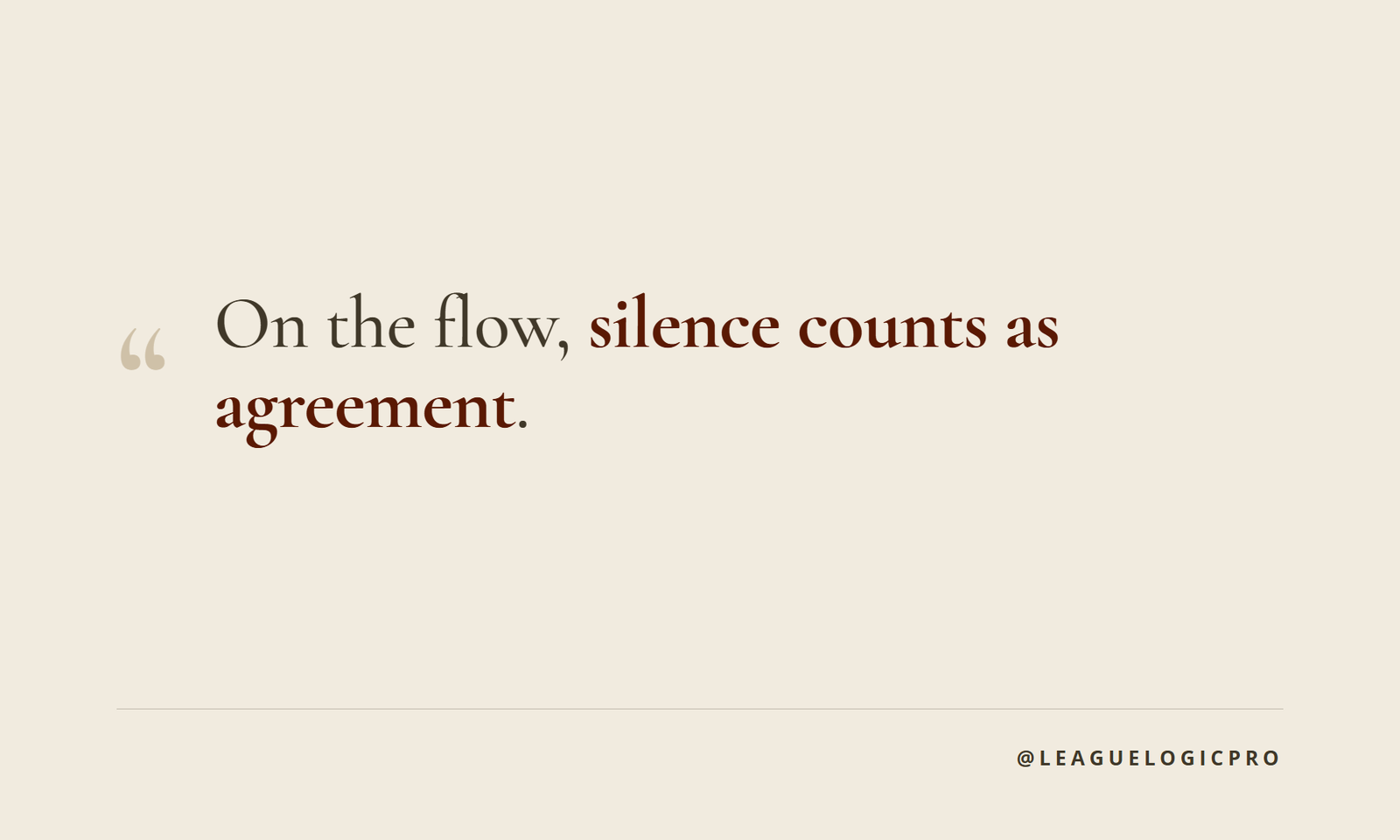
And on the flow, silence counts as agreement. A dropped argument doesn't fade away - the judge hands it, whole, to the team that made it. That one fact explains more about how rounds are won and lost than any technique you'll pick up this season.
The tournament words: prelims, breaking, and the ballot
The tournament words mark a ladder, and every story you heard in that circle is really a report of where someone stood on it.
Every team debates the prelims, the seeding rounds. Do well enough there and you break: you advance into the outrounds, the elimination rounds - octos, quarters, semis, finals - where one loss ends your run (you stay for awards with everyone else, but your bracket is done). Breaking for the first time is the milestone nearly every novice is chasing, which is why "we finally broke" gets said with that particular shine.
Then the tournament ends and your ballots arrive on your account: one judge's scoresheet and written feedback for every round you debated. The heart of each ballot is the RFD - the Reason For Decision, the judge's own explanation of who won and why. Alongside it sit your speaker points, the score for how you spoke, tracked separately from whether your team won.
Tucked inside those three words is the quiet advantage of this whole game: feedback is built in. Every round ends with a real person telling you exactly how it landed for them. The debaters who climb the ladder fastest aren't the ones who never get a confusing ballot. They're the ones who learn to mine one.
Say them out loud this week
Maybe the words still feel like a club you haven't been let into. So here's the truth about that circle: every finalist you're scared of once nodded along, pretending too. The novices who stop being novices fastest aren't the ones who wait quietly until the words make sense. They're the ones who start saying the words while they're still new.
So use them this week. Ask a veteran how they tag their cards. Ask what case they're building and whether anyone has briefed it yet. Clubs are just spinning back up and the whole league is deep in case-building season, which makes right now the easiest moment of the year to ask - half your club is figuring out the new resolution right beside you.
And if you want to see every one of these words working in one place, grab the free case on this year's Turkey resolution. It comes complete - the full affirmative case, the aff backup, and the neg brief written against it - so you can hold a real 1AC, watch taglines and briefs do their jobs, and walk into your next meeting a step ahead of the vocabulary. Get the free case bundle here.