

It's a Tuesday night, and your debater is standing in the living room with their case pages in hand, halfway through the first contention. They stop and look up: "Does that make sense?"
And you freeze. You've driven to every club meeting. You've watched them grow into this world of briefs and rebuttals. But the honest answer is that you don't know if it makes sense, and somewhere under that is a quieter worry: that your not-knowing is the ceiling on how far they can go.
It isn't. You don't need to learn cross-ex, flowing, or a single line of debate theory to help your debater thrive this season. The four moves below are the support that actually moves a season forward, and every one of them runs on something you already know how to do.
Be the audience, not the coach
Your student doesn't need you to evaluate their arguments. They need you to hear them - out loud, all the way through, more than once.
Here's why that matters more than it feels like it does. A case gets strong in the reading, not the writing. Every out-loud pass smooths a transition, catches a sentence that looked fine on paper and stumbles in the mouth, and builds the calm that shows up later in a real round. Your living room is where those reps happen, and reps need a listener.
And think about who actually judges in this league. Some judges are seasoned alumni who have heard a hundred rounds. Plenty of others are parents volunteering for their very first one. Your student will need to be clear enough, warm enough, and organized enough to win over someone exactly like you.
So when you listen and something loses you, say so. "I got lost after the second point" is not a failure of your knowledge. It's the single most useful piece of feedback in the house.
If they can make their case clear to you, they can make it clear to any judge.
Ask the questions that make them explain
"How's the case going?" gets you "fine." A better question gets you a rehearsal.
Explaining something is how you find out whether you actually know it - every teacher and every homeschool mom has lived that truth. When your debater walks you through an argument in their own words, they're not reporting on their prep. They are doing the prep, and dinner just became a practice round.
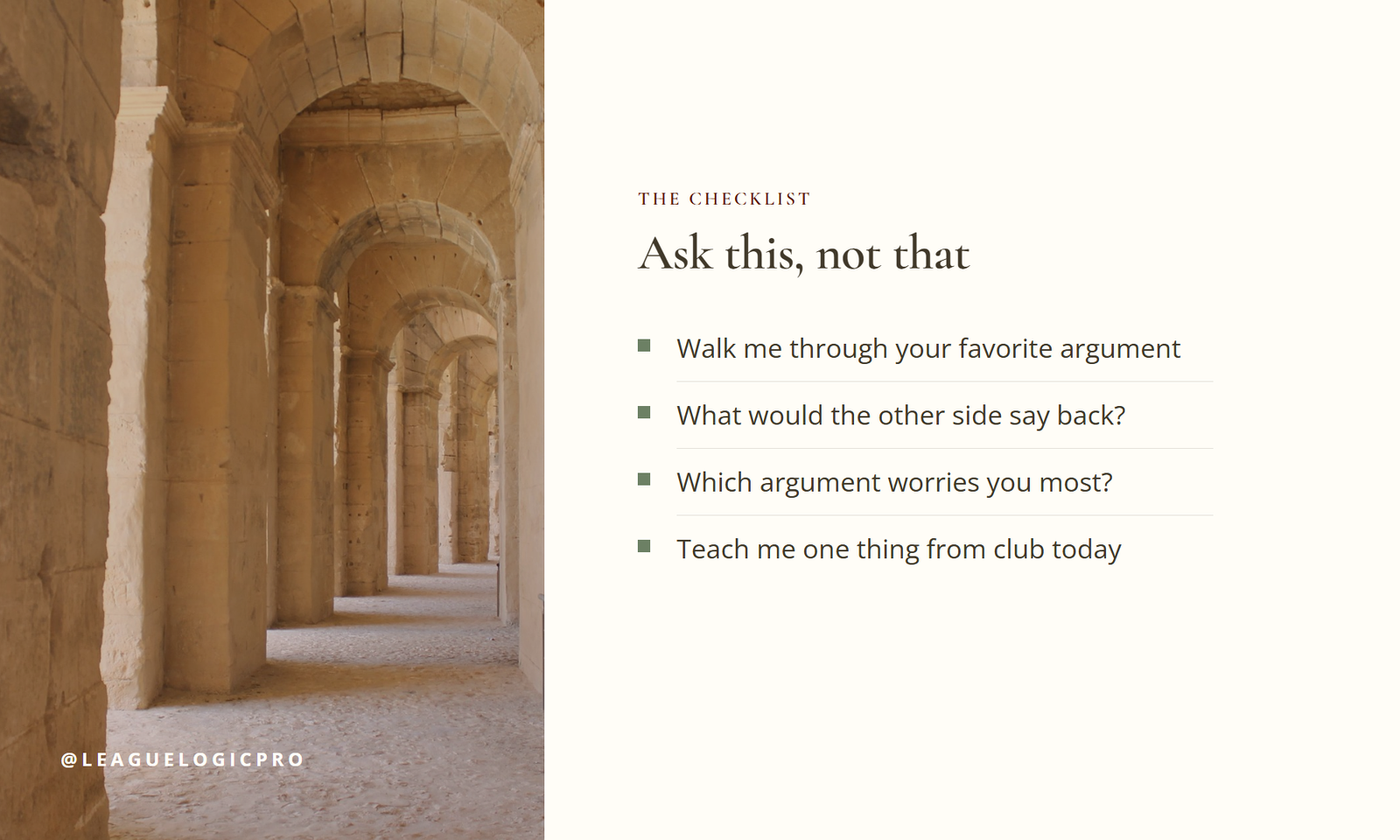
Keep a few of these in your pocket:
- "Walk me through your favorite argument."
- "What would the other side say back?"
- "Which argument worries you most?"
- "Teach me one thing from club today."
Then do the hard part: stay curious, not corrective. You're not checking their answers. You're giving their thinking a place to happen out loud.
Every explanation is a practice round you didn't have to schedule.
Own the rhythm, not the arguments
In this league, half of a strong season is rhythm, and rhythm is something you already run.
You may not write briefs, but look at what a debate season actually asks of a family. Someone keeps the club meetings and tournament dates on the calendar so prep isn't a last-minute scramble. Someone makes sure the printer has ink the week the case gets finalized, and that the debate box is packed and by the door the night before, not in the morning rush.
Someone protects a quiet hour for practice in a week that's already full, and someone drives - to club, to the tournament, through the quiet ride home after a hard loss. None of that shows up on a ballot, and all of it shows up in how prepared and how steady your student walks in.
That work has a name. It's not "support around the edges." It's the platform they stand on.
You're not the coach. You're the home base.

Let the expert work be someone else's job
The parts of debate that do need an expert - deep research, strategy, tough drilling - don't have to come from you.
They come from the club coach who runs practice rounds. From the advanced debaters and alumni your student watches and learns from. And from structured prep tools, if you choose them the way you'd choose any curriculum: carefully.
The standard to hold is simple. Real sources your student can find and check for themselves - here's how to check that every source holds up - and structure that makes your student think more, not less. If a tool hands them polish without understanding, it fails your test. If it hands them a strong starting point they still have to read, question, and make their own, it passes.
Your role isn't to be the expert. It's to make sure trustworthy expertise is in the room - and if research nights are eating your student's whole week, this one is worth passing along to your debater.
The part only you can do
Maybe this list feels small next to what other debate families seem to know. It isn't. Seasons are long, and the student who gets listened to, questioned, organized, and cheered at home has an advantage no theory book gives.
Start tonight. Ask for their favorite argument, and just listen.
And if you want their season to start from a strong, checkable foundation, grab the free case on this year's resolution - the full aff case, the aff backup, and the neg brief written against it, every source real and checkable by your student.
You bring the home base. The season will bring the rest.
Companion reads: How to Verify Debate Evidence → · Cut Debate Cards Faster →