
Picture the round that decides whether you break at Regionals. Their first speaker stands up, and inside of a minute you know: they have your case. Not a guess at it. The actual brief, printed and tabbed, with the disadvantage you first heard at your very first tournament and never quite finished answering.
You could give this 1AC in your sleep by now, and that's exactly the problem. There's no other case in your debate box.
An experienced debater wrote back to one of our emails this month and put it plainly. By the end of her first Team Policy season she wished she'd had a second case to reach for, but she had months of work on one case and nothing on any other. This season she's starting a second one early. She's right, and the reason is worth a closer look, because the same calendar is sitting in front of you right now.
Here's what a season does to a case, why the second one never gets built in the spring, and how to start it now without dropping the first.
What your case looks like by Regionals
Right now your case is new. Nobody has hit it, and unless it came straight out of a sourcebook, nobody has a brief for it. That lasts until about your second tournament.
Then the season does what it does. The team you beat at your first tournament cuts answers on the drive home. Somebody in a brief ring gets your case as their assignment, writes the brief, turns it in, and unlocks it for everyone else in the ring. By Regionals, the strong teams in your region don't need to figure your case out in cross-ex. They've read it.
And you're tired of it too. You've heard every answer to it twice. You know which advantage you stop believing in somewhere around the 2AC, and you've been meaning to fix that plank for months. A case you've run at four tournaments is a case you know cold, which is worth a lot. It's also a case everyone else knows.
By Regionals your case isn't a surprise. It's a tab in somebody's debate box.
Why "I'll build one in the spring" never happens
The plan is always the same: run this case through the first few tournaments, then build a second one once things settle down. Things never settle down.
Look at what the spring actually holds. A tournament every few weeks, the drive there and back, speech events on the same trip, schoolwork that didn't stop, and the neg briefs you still owe your partner for the confirmation list. A second case takes the same weeks of reading the first one took: real sources, cards you've cut yourself, a plan you can defend from every side, and then the hours of quizzing yourself until you know it cold. That work doesn't fit between tournaments. It has to start now, in the weeks before your first one.
You already know what a case built in March looks like. You run it once, lose to an argument two more weeks of reading would have shown you, and go back to the old case for the rest of the season. The rushed second case doesn't save you. It costs you a round.
You don't have time to build a second case? Not in the spring, you don't. That's the whole point. The best time to build a second case is while you don't need one yet.

Pick a case the first brief can't touch
The worst second case is a cousin of your first one. If case one is about arms transfers and case two is a different arms transfer, the brief that beats one beats both, and you've spent your calm weeks building nothing.
Move to a different part of the resolution. Different harms, a different plan, a different stack of sources. If case one lives in arms transfers, look at sanctions, or the other way around. The generic answers will follow you anywhere on this resolution. The specific ones, the ones that actually beat a case, won't.
Then use what the first case taught you. You already know where case one is soft: you've heard the attack in cross-ex, or you've felt it coming and changed the subject. Build the second case to be strong exactly there. You also know by now which arguments you make well in a round. Pick a case that lets you make them.
The second case doesn't have to be your favorite. It has to be the one you can still defend when the first one is out of surprises.
The one-hour rule
Here's the habit: one hour a week for case two, every week, from now until your first tournament. Not an afternoon. One hour, with one job.
Week one, pick the topic and read two real sources all the way through. Week two, cut the harms. Week three, draft the plan. Keep going.
Cut every card yourself and check every citation before you trust it, the same standard you held case one to. One hour never feels like much in any given week, and that's exactly why it survives the weeks when nothing else does.
Split it with your partner. One of you takes the harms, the other takes the plan and solvency, and you swap what you find. An hour of reading each, and neither of you feels it.
By your first tournament you should have a rough 1AC and a stack of cards. You won't run it there. Run the case you know.
But start running case two in practice rounds at club, where the losses are free, and let your clubmates find its holes before a judge does. Every practice round is a brief somebody would have written against you, handed over early. (Not sure the 1AC is landing? Here's how to build one judges can follow.)
Then keep it warm through the season. A card here, a quiz there, a practice round when you can. By Regionals, case two isn't a rush job. It's a case you've known for months that almost nobody has hit.
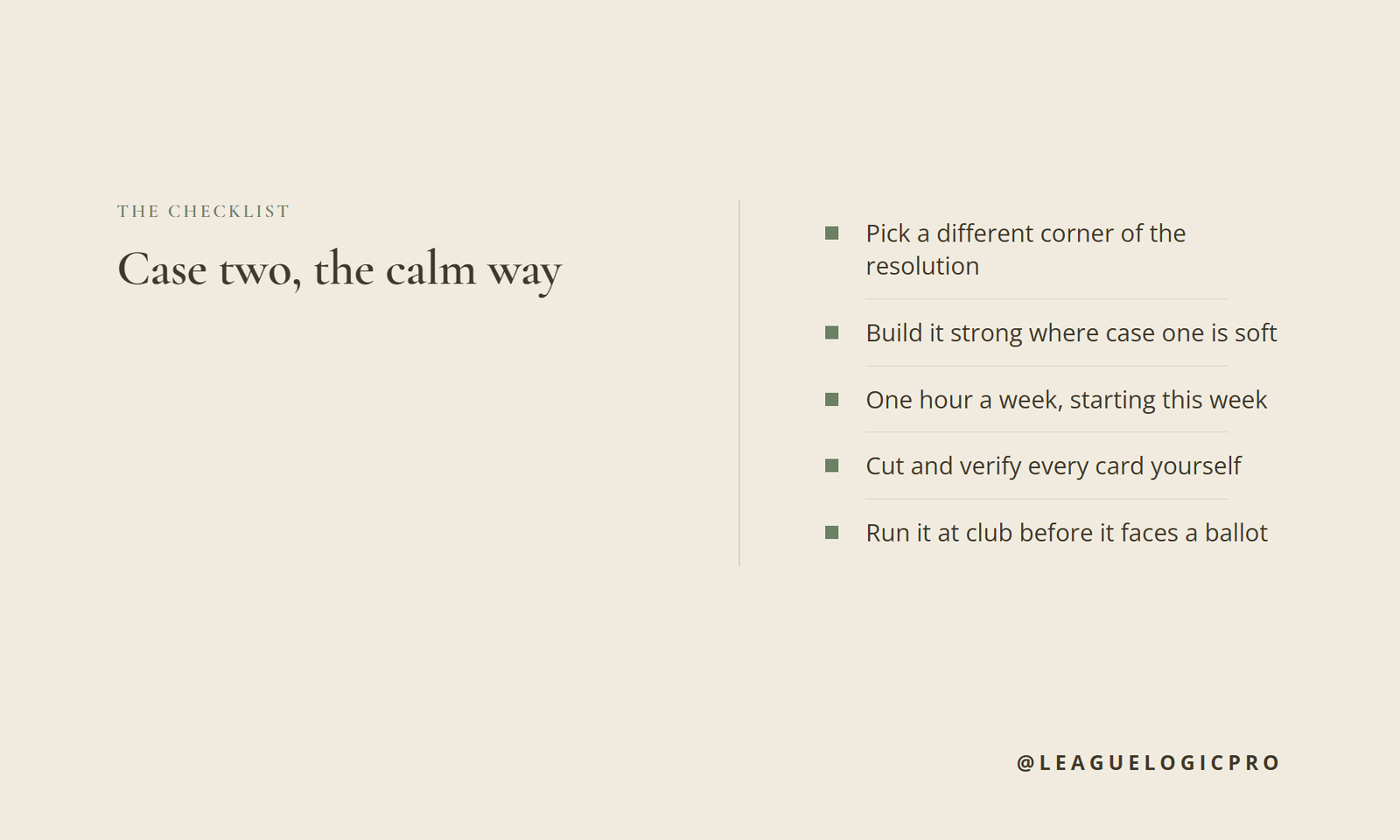
One case is a plan. A second case is a choice.
Nobody's asking you to walk into your first tournament with two cases. Run the one you know, and run it well. But give the second one an hour a week now, while the calendar is still quiet, and by Regionals you're the team that gets to choose. Two cases in the box, both of them yours. And the brief they brought is for the one you're not running.
If you want a running start, grab the free case on this year's Turkey resolution. It comes complete: the full affirmative case, the aff backup, and the neg brief written against it. It's built with more facts, harms, and advantages than fit in one 1AC on purpose, so you read it, keep what's strongest, and make it yours. And that neg brief shows you what a case looks like from across the room once somebody's had time to prepare for it, which is the whole reason case two exists. Get the free case bundle here.