
You spent a week on this 1AC. Your sharpest harms, a plan you can defend from any angle, an advantage you're genuinely proud of. Then the ballot comes back: "Hard to follow in the middle. Wasn't sure how the second advantage linked."
Not "the neg beat you." Not "I disagree." Just - couldn't follow it.
Here's the part that stings: you didn't lose that argument. You lost the judge. The case was good. It just never landed on the flow in one piece, so the judge voted on the version they could track - and that wasn't yours.
A 1AC that wins isn't the smartest one in the room. It's the one the judge can flow, top to bottom, without ever getting lost. Here are four moves that get you there.
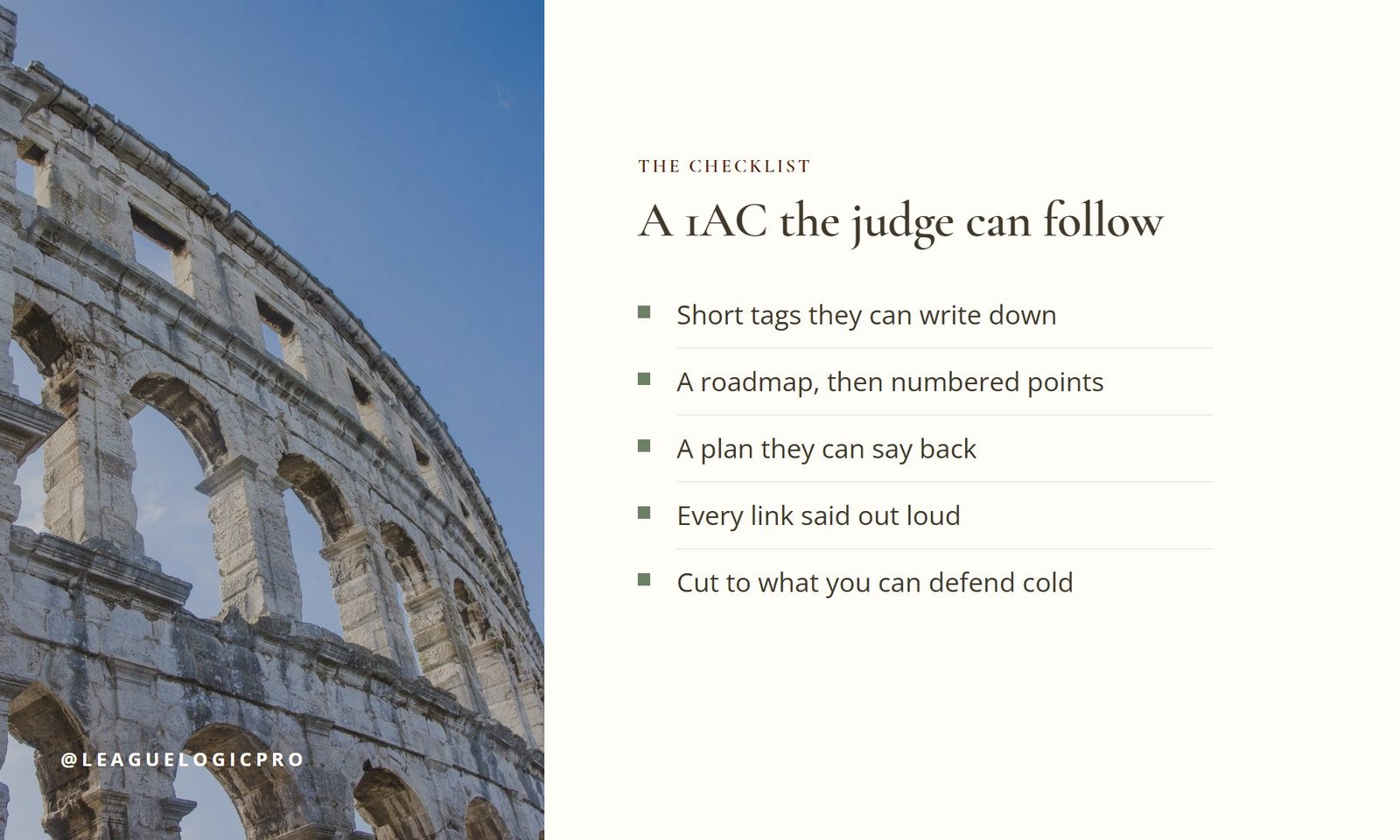
Write tags the judge can write down
Your tagline is the sentence the judge copies onto the flow. If it takes three clauses to get there, they write down half of it - or the wrong half.
Picture a tag like this: "The current framework governing US arms transfers to Turkey has created a strategic dependency that quietly erodes American leverage across the region." By the time the judge untangles that, you're two cards ahead and their pen never moved.
Now lead with the claim instead: "Our arms deals hand Turkey leverage over us." Then the next card: "The plan takes that leverage back." Short. Subject, verb, point. The judge writes the whole thing and has a hook to hang your evidence on.
Read your 1AC out loud and mark every tag you can't say in one breath. Those are the exact lines the judge can't get down in one pass.
The judge votes off the flow, not off how smart you sounded.

Signpost like a map, not a maze
A 1AC the judge can follow has a spine they can see early. Give a quick roadmap, then label every move as you make it. Harms here. Plan here. Advantages here.
Number your points so the judge's pen always knows where to land. When you slide from your second harm straight into a solvency card with no signpost, the judge is still writing the harm and never catches that the card was your link.
That's what "hard to follow in the middle" almost always means. Not a content problem - a navigation problem. The judge lost the thread and never found it again.
Signposting isn't decoration you sprinkle on for style. It's the difference between an argument the judge flows and one they quietly drop.
Build a plan the judge can say back
The plan is the one thing every judge has to hold onto. If they can't say it back, they can't vote for it.
Think about the judges you actually get across a tournament: a seasoned alum in one round, a mom judging her third round ever in the next. If that parent judge can't repeat your plan in a sentence when the round is over, it's too tangled - no matter how airtight it reads on paper.
Keep the planks short and in order. Don't bury your mandate inside the funding plank. A plan the judge can restate in their own words is a plan they'll carry for you into the decision.
Say your links out loud
Here's the trap that kills clever cases. You can see exactly how your harm, your plan, and your advantage connect - so you assume the judge sees it too. They don't.
The judge only flows what you say, not what you meant. You know your second advantage grows straight out of the plank you read a minute ago. To the judge, those are two separate notes with nothing drawn between them - until you draw it.
So say the link out loud, in one plain sentence, every time: this is the harm, this is how the plan fixes it, this is what we gain. It will feel too obvious to bother saying. Say it anyway.
An unspoken link is an unflowed link. If you didn't say it, the judge didn't hear it.
Build the case now, while it's still yours to shape
Four moves, one goal - a 1AC the judge can follow without working for it. Tags short enough to write down. Signposts they can't get lost in. A plan they can say back. Links you say out loud.
None of that happens the night before your first tournament. It happens now, early in the season, while you still have time to read your evidence, verify every card and drill the case out loud until the structure is automatic.
And the strongest 1AC isn't the one with the most cards. It's the one you cut down to what you can explain cold and weigh under pressure. That cutting - deciding what's strongest, what fits your slant, what to leave on the table - is the work that turns a starting point into your case.
That grunt work of getting to a strong starting point is exactly what League Logic Pro's Aff Assistant speeds up. It opens with 40+ verified cases on the Turkey resolution, across eight reform categories, each with a background to read - so you pick the ones that fit your style instead of running the same case as everyone who bought the same sourcebook.
Every source is real and checked twice, so you're never up defending a card you can't stand behind. You quiz on your own case until you know it cold, and when a ballot comes back rough, Strategy Chat helps you turn it into your next fix. You still cut it to your slant. You still own it in the room.
It's a faster, stronger place to start - not a shortcut around understanding what you run.
It's $29, once. That's up to six case builds for the year, and the dashboard stays open all season, through Nationals. No subscription, no renewal.
The judge can only vote for the case they can follow. Build that one while it's still yours to shape - start with Aff Assistant.
Companion reads: How to Verify Debate Evidence → · Cut Debate Cards Faster →